Why Your Matcha Tastes Bitter When You Do Everything Right
Quick Answer: Bitter matcha usually comes from water that is too hot (over 175°F/80°C), too much powder for the volume, over-whisking that keeps extracting, or matcha that has oxidized in storage. Fix temperature first — drop to 160–170°F/71–77°C — then reduce to 1 teaspoon per 2 ounces of water and whisk for only 15 to 20 seconds.
You bought the good stuff. You watched the videos. You own a bamboo whisk that cost more than you would admit.
And it still tastes harsh in a way the café version never does.
The frustrating truth is that most bitterness problems are not technique failures in the dramatic sense — they are four small variables, and almost everyone gets at least one of them wrong without knowing it.

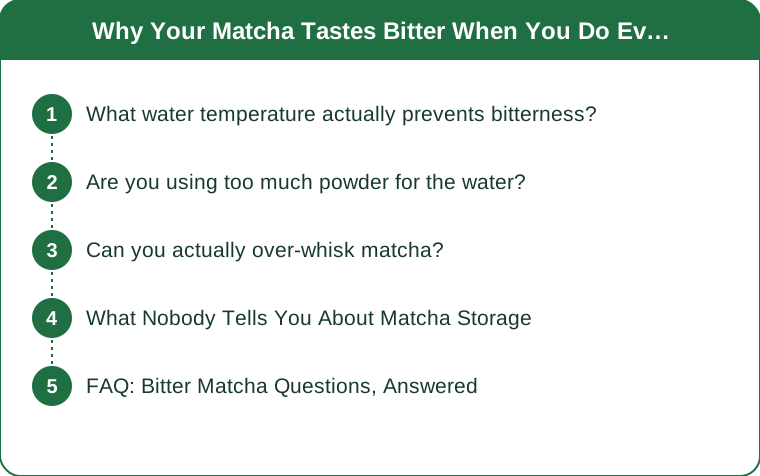
What water temperature actually prevents bitterness?
Between 160°F and 175°F (71–80°C), and the difference between 175 and 195 is enormous.
Matcha contains catechins — the compounds responsible for astringency — and their extraction rate climbs steeply with heat. Boiling water extracts roughly twice the bitter compounds that properly cooled water does, and it happens in seconds.
Without a thermometer, two reliable methods:
- Boil and wait. Water off a full boil sits near 200°F. It drops roughly 10 degrees every 60 to 90 seconds in an open cup at room temperature, so five minutes gets you into range.
- Pour between two vessels twice. Each transfer drops the temperature about 10 degrees. Boil, pour into a second cup, pour back, wait a minute.
If you are using a variable-temperature kettle, the green tea setting is often 175°F, which is the top of the acceptable range rather than the sweet spot. Set it manually to 165°F and taste the difference immediately.
Heat is the single largest lever, and it is the one most people skip because it feels fussy.
Are you using too much powder for the water?
Very likely. The standard scoop advice produces a concentrated drink that reads as bitter even when nothing else is wrong.
The workable ratio is 1 teaspoon (about 2 grams) per 2 ounces of water for usucha, the everyday thin style. Many people use a heaping teaspoon into 1.5 ounces because that is what the tin says, and the result is closer to a concentrate.
If you are making a latte, the math changes: 1 teaspoon into 2 ounces of water first, whisked properly, then topped with 6 ounces of milk. Whisking matcha directly into milk is a common shortcut and it does not disperse properly — you get clumps and uneven, sharp-tasting sips.
A cheap kitchen scale removes the guesswork permanently. Two grams is remarkably hard to eyeball, and teaspoon sizes vary by more than people assume.

Can you actually over-whisk matcha?
Yes, though not in the way most people imagine.
Whisking does not chemically damage the tea. What it does is extend contact time between water and powder while the water is still hot, which continues extraction. A 45-second whisk in 175-degree water pulls noticeably more astringency than a 15-second whisk.
Technique specifics:
- Whisk in a W or M pattern, not circles. Circles push powder to the sides and require more time.
- Use your wrist, not your arm. Fast and light beats slow and forceful.
- Stop at a fine, even foam — roughly 15 to 20 seconds. Chasing a thick meringue-like layer is an aesthetic goal, not a flavor one.
And sift the powder before adding water. Clumps are not just texture — an unbroken clump means the surrounding liquid is over-concentrated relative to the rest, and the sip where it finally breaks apart tastes sharply bitter.
What Nobody Tells You About Matcha Storage
Your matcha may have been fine when you bought it and turned bitter in your cupboard.
Matcha is a fine powder with enormous surface area, which makes it one of the fastest-oxidizing things in a kitchen. The changes are gradual enough that you blame your technique rather than the tin.
What actually degrades it:
- Oxygen. An opened tin loses noticeable quality within four to six weeks even when sealed well.
- Light. Clear containers on a counter are the worst-case scenario. The vivid green fades toward olive, and the flavor follows.
- Heat. Storing it above the stove or near a window is enough to matter.
- Humidity. Moisture causes clumping and accelerates everything else.
The counterintuitive part: refrigerating an opened tin often backfires because condensation forms every time you take it out. Cold storage works only if the container is fully airtight and you let it reach room temperature before opening.
The practical answer for most people is buying smaller tins more often — 30 grams rather than 100 — and keeping them sealed, opaque, and away from the stove. Olive-toned powder is telling you something before you ever taste it.
And the honest one nobody wants to hear: culinary-grade matcha is bitter by design. It is bred and processed for baking, where sugar balances it. No amount of temperature control makes it taste like ceremonial grade straight.
FAQ: Bitter Matcha Questions, Answered
Should I add anything to reduce bitterness?
A small amount of milk or a few drops of honey masks astringency effectively, and there is nothing wrong with that. But if you need it every time, the underlying variable — usually temperature or grade — is still worth fixing.
Does the whisk material actually matter?
Somewhat. A bamboo chasen with 80 or more tines disperses powder better than a metal or electric frother, which mainly aerates. That said, technique and temperature matter far more than the tool, and a milk frother with correct water temperature beats a chasen with boiling water.
Why does café matcha taste smoother than mine?
Usually ratio and milk. Most café matcha lattes use a modest amount of powder in a large volume of milk with added sweetener, which softens astringency substantially. Their matcha is not necessarily better than yours — it is diluted differently.
TL;DR:
- Drop water temperature to 160–170°F. This is the biggest single fix.
- Use 1 teaspoon (2 g) per 2 oz of water, and weigh it once to calibrate your eye.
- Sift, whisk in a W pattern for 15–20 seconds, and stop at fine foam.
- Store opened tins airtight, opaque, cool, and buy small — matcha oxidizes fast.
- Culinary grade is bitter by design; no technique makes it taste ceremonial.
Work through those in order and most people find the problem in the first two. The nice part is that once your temperature and ratio are calibrated, the whole thing becomes a 90-second habit rather than a project.
Keep Reading
This article is for general informational purposes only and is not medical advice. Always consult a qualified health professional for guidance specific to you.