Why Matcha Costs More Than Coffee, and How to Lower It
Quick Answer: A 30g tin of good ceremonial matcha at 25 to 35 dollars makes about 15 servings, so you are paying roughly 1.70 to 2.30 per cup — against about 30 to 50 cents for home-brewed coffee. The gap comes from labour-intensive shade growing and stone milling, not from branding. The three changes that lower it most are weighing your scoop, buying the tier below ceremonial for lattes, and buying larger tins from importers rather than 30g tins from cafés.
You do the maths once and it is a bit startling.
The tin lasted three weeks, it cost 32 dollars, and you have somehow constructed a home habit that costs more per cup than the coffee shop you were trying to stop going to.

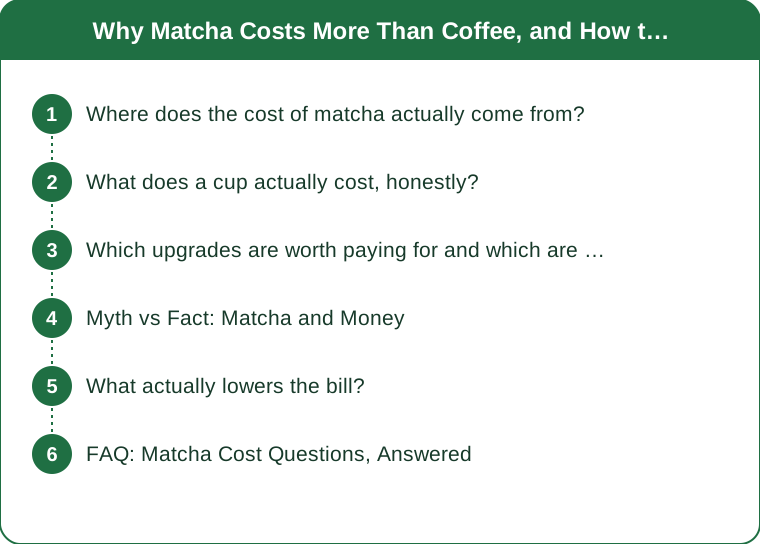
Where does the cost of matcha actually come from?
Shade growing, hand picking, and stone milling — three genuinely expensive processes that have no equivalent in coffee production.
Shading. For three to four weeks before harvest, the plants are covered to block most sunlight. This forces the leaves to produce more chlorophyll and more L-theanine, which is what creates the colour and the sweetness. It also reduces yield substantially — you are getting less tea from the same plants, deliberately.
Hand picking. The best grades are picked by hand, taking only the youngest leaves from the first harvest. Later harvests and machine picking produce cheaper, more bitter tea.
Stone milling. Granite mills turn processed leaf into powder at roughly 30 to 40 grams per hour. One mill produces less than a kilogram in a full day. This single fact explains more of the price than anything else.
Coffee, by contrast, is grown in full sun, harvested at volume, and ground in seconds. The gap is a production reality, not a markup, which is why very cheap matcha is usually a different product rather than a bargain.
What does a cup actually cost, honestly?
Between 1.20 and 2.50 for most people, and the scoop size matters more than the tin price.
The arithmetic: a standard serving is 2 grams. A 30g tin therefore gives 15 servings.
- 30g tin at 25 dollars = 1.67 per cup
- 30g tin at 35 dollars = 2.33 per cup
- 100g tin at 55 dollars = 1.10 per cup
Home coffee for comparison: a 340g bag of good beans at 18 dollars makes about 24 cups at 14g each, which is 75 cents a cup. Supermarket beans land closer to 30 to 40 cents.
The hidden variable is your scoop. Most people using a bamboo scoop take between 2 and 4 grams without realising, because a heaped scoop is nearly double a level one. If you are habitually taking 3.5 grams, your real cost is 75 percent higher than the calculation above — and your matcha is probably also more bitter than it should be. Weighing it once, to see what your normal scoop actually is, is genuinely revealing.
Which upgrades are worth paying for and which are not?
Grade matters for drinking straight and barely matters in a latte. Equipment barely matters at all.
Worth paying for: ceremonial grade, if you drink it with water. With nothing to hide behind, the difference between a 20-dollar and a 35-dollar tin is obvious — bitterness versus sweetness, dull green versus vivid green.
Not worth paying for: ceremonial grade in a latte. Milk and any sweetener flatten most of the subtlety you paid for. A good premium or latte grade at half the price is close to indistinguishable once milk is involved, and this is the single largest saving available to most people.
Worth it once: a scale. A cheap kitchen scale that reads to 0.1g costs very little and immediately stops the invisible overpouring that inflates both cost and bitterness.
Marginal: the whisk. A proper bamboo chasen makes better foam than a milk frother, but the difference in the actual tea is small. If you have a frother, it is fine.
Not worth it: expensive bowls, sifters, and starter kits. A wide cereal bowl and a small fine sieve do the same job.

Myth vs Fact: Matcha and Money
Myth: Expensive matcha is mostly branding. Fact: Some of it is, particularly in western-facing lifestyle brands. But the underlying production cost gap between first-harvest hand-picked leaf and later-harvest machine-picked leaf is real and large. Blind tastings consistently separate the tiers.
Myth: Buying in bulk always saves money. Fact: Only if you drink it fast enough. Matcha oxidises noticeably within four to six weeks of opening, and a 200g tin that takes four months to finish is a false economy — you spend the last two months drinking dull, flat tea. Buy the size you will finish in six weeks.
Myth: Culinary grade is bad matcha. Fact: It is different matcha — later harvest, more astringent, designed to hold up against sugar and heat. In baking it outperforms ceremonial, which mostly disappears. Using ceremonial grade in brownies is the most common way people waste money on matcha.
Myth: A matcha habit is cheaper than a café habit, so it is already a saving. Fact: True, and worth keeping in view. A café matcha latte is 5 to 7 dollars. Even an expensive home habit at 2.30 is a substantial saving; the comparison that makes matcha look costly is home coffee, not the café.
What actually lowers the bill?
Weigh it, split your grades, and buy from importers in the right size.
Weigh your serving for a week. Most people discover they are using 3 to 4 grams. Dropping to a measured 2 grams cuts cost by a third and usually improves the taste, since over-scooping is a leading cause of bitterness.
Run two tins. A good ceremonial grade for straight matcha, and a cheaper premium grade for lattes and iced drinks. This alone typically cuts a mixed habit’s cost by 30 to 40 percent with no perceptible loss.
Buy 40 to 100g from a specialist importer rather than 30g from a café or a lifestyle brand. Per-gram cost drops meaningfully, and importers usually list harvest date, which the resellers rarely do.
Check the harvest date rather than the best-before date. Best-before is set from packaging; harvest date tells you the actual age. First-harvest tea from the current year is what you want, and older stock is often discounted for a reason.
Store it properly so you do not throw away the last third. Airtight, in the fridge, brought to room temperature before opening to avoid condensation. Poor storage is a real cost — a tin that goes dull at the halfway point has effectively doubled its price per usable cup.
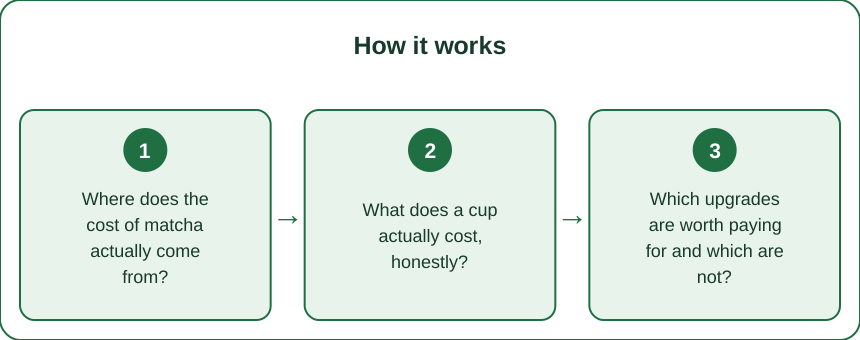
FAQ: Matcha Cost Questions, Answered
Is a 15-dollar tin ever any good?
For lattes, sometimes yes — look for Japanese origin, a stated harvest date, and a vivid green colour. For drinking straight, rarely. Very cheap matcha is usually later-harvest and tastes noticeably astringent without milk to soften it.
Does matcha have more caffeine than coffee per cup?
Less, generally. A 2g serving delivers roughly 60 to 70mg of caffeine against about 95mg for a standard cup of coffee. The reason matcha feels different is L-theanine, which slows the delivery rather than reducing the dose.
How long does a 30g tin actually last?
About 15 servings at 2 grams, so two weeks at one a day if you are measuring — closer to ten days if you are not. That gap is the whole argument for owning a scale.
Is dull-coloured matcha still safe to drink?
Yes, it is just oxidised — flatter, more bitter, less sweet. Use it for baking or lattes rather than discarding it, which recovers most of the value.
TL;DR:
- A cup of home matcha typically costs 1.20 to 2.50 against 30 to 75 cents for home coffee, and the gap is production cost rather than markup.
- Shade growing, hand picking, and stone milling at 30 to 40 grams per hour are where the money goes.
- Weighing a 2g serving, using a cheaper grade for lattes, and buying 40 to 100g from importers are the three biggest savings.
- Buy only what you will finish in six weeks — oxidised matcha is the most common hidden cost.
Weigh your usual scoop tomorrow morning. If it comes out over 2.5 grams, you have just found a third of your matcha budget.
Keep Reading
This article is for general informational purposes only and is not medical advice. Always consult a qualified health professional for guidance specific to you.