Why Matcha Hits Your Anxiety Differently Than Coffee Does
Quick Answer: A cup of matcha delivers roughly 60 to 70mg of caffeine, similar to a weak drip coffee, but it also delivers 20 to 45mg of L-theanine - an amino acid that raises alpha brain wave activity and blunts the sharp arousal spike caffeine produces on its own. Add the slower absorption from suspended powder and catechin binding, and the same dose of caffeine arrives over roughly two hours instead of forty minutes. That is the whole difference.
It is not that matcha has less caffeine. It is that it arrives differently.
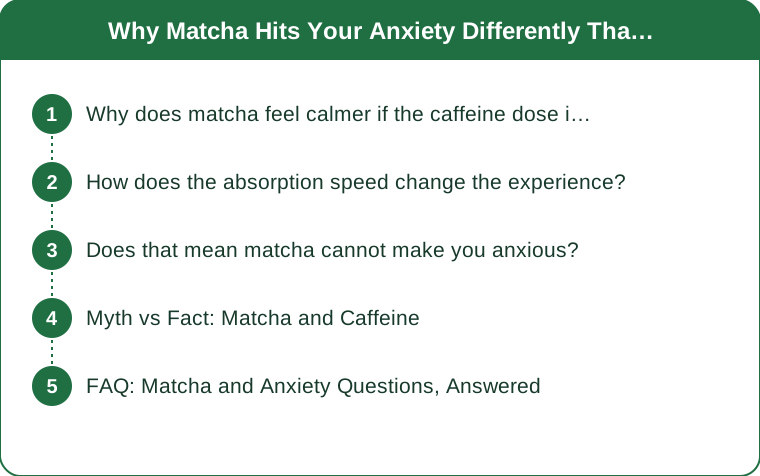
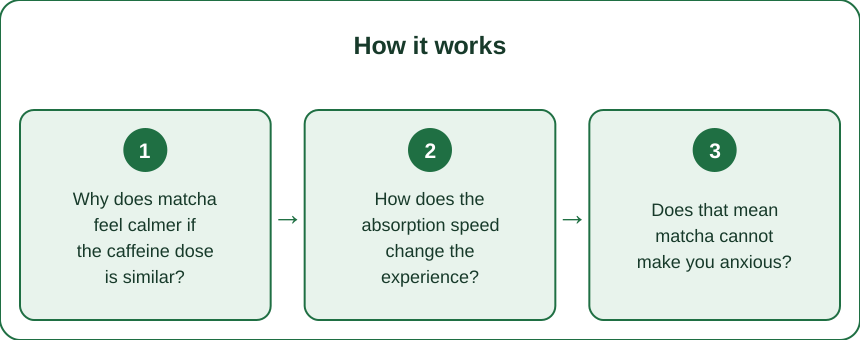
Why does matcha feel calmer if the caffeine dose is similar?
Because caffeine is not the only active compound in the cup, and the second one directly counteracts the part of caffeine people dislike.
L-theanine is an amino acid found in tea leaves and in almost nothing else you eat. It crosses the blood-brain barrier and increases alpha wave activity - the brain state associated with relaxed alertness, the same one that shows up during light meditation. On its own it is mildly calming. Paired with caffeine, the combination has been studied repeatedly, and the consistent finding is that the pair improves sustained attention while producing less of the arousal and self-reported jitteriness that caffeine alone causes.
Matcha carries substantially more theanine than steeped green tea for a simple physical reason. You drink the whole leaf. Steeping extracts a portion of the water-soluble compounds and leaves the rest in the leaf you throw away. Whisking powdered leaf into water means every molecule that was in that leaf ends up in your cup - theanine, caffeine, catechins, chlorophyll, all of it.
Shade-growing amplifies this further. Matcha plants are covered for roughly three to four weeks before harvest, which reduces light, slows photosynthesis, and causes the plant to accumulate theanine rather than converting it into catechins. That is also why good matcha is sweet and umami rather than sharply bitter - theanine tastes savory-sweet, and there is simply more of it.
The practical ratio matters more than the absolute amounts. A theanine to caffeine ratio around 1:2 or better is where the calm-alert effect shows up reliably. Ceremonial-grade matcha from a well-shaded harvest lands in that range. Culinary grade, from later harvests with less shading, often does not - which is one reason people who switch to cheap matcha report it feeling more like coffee than they expected.
How does the absorption speed change the experience?
This is the underrated half of the answer, and it explains why matcha rarely produces the crash.
Coffee caffeine is dissolved in water. It hits your stomach as free molecules, absorbs rapidly through the small intestine, and blood levels typically peak within 30 to 60 minutes. That fast rise is what produces the noticeable lift, and it is also what produces the noticeable drop when levels fall.
Matcha caffeine is largely bound to catechins - specifically to EGCG and related polyphenols that are abundant in green tea. Those complexes have to dissociate before the caffeine is free to absorb, which spreads the release across a longer window. Peak levels arrive later and lower, and the curve descends gently rather than dropping.
What that produces subjectively:
- A lift you notice after 20 to 30 minutes rather than 10
- A plateau that holds roughly two to three hours instead of a peak and a fall
- No distinct crash point, because there is no sharp peak to fall from
- Less stomach reaction, since the acidity is lower and the caffeine is not arriving all at once
You are also drinking a suspension rather than a solution. Matcha particles settle, which is why the bottom of a bowl left standing tastes stronger - and why whisking properly and drinking within a few minutes gives a more consistent experience than sipping the same bowl over half an hour.
Does that mean matcha cannot make you anxious?
No, and this is where the wellness framing overstates things.
Caffeine is still caffeine. If you are caffeine-sensitive, if you drink four bowls, or if you are already running on four hours of sleep, matcha will produce anxiety. Theanine softens the arousal response; it does not delete it.
Several things reliably undo the calm effect:
- Volume. Three or four bowls stacks 200mg-plus of caffeine, and theanine does not scale protectively at that dose.
- Low-grade powder. Later harvests, less shade, less theanine, worse ratio. The cup behaves more like coffee.
- Empty stomach plus sleep debt. Both amplify caffeine’s effect on cortisol and heart rate regardless of source.
- Scooping by eye. A heaped scoop can be double a level one, which means people who think they are having a consistent dose often are not. This is the single most common reason matcha feels different day to day.
- Existing anxiety disorders. Caffeine is a known aggravator, and the theanine effect is not large enough to make it safe if caffeine is already a trigger for you.
There is also an individual genetic component that gets ignored. CYP1A2 is the liver enzyme that clears caffeine, and its activity varies substantially between people. Slow metabolizers keep caffeine in circulation far longer, and for them an afternoon matcha still affects sleep even though it felt gentle at the time. If caffeine of any kind at 2pm affects your night, that is likely the explanation, and switching source will not fix it.
This is general information, not medical advice. If anxiety or heart palpitations are a recurring problem, that is worth raising with a clinician rather than solving through beverage choice.
Myth vs Fact: Matcha and Caffeine
Myth: Matcha has more caffeine than coffee. Fact: A standard 2g serving of matcha delivers roughly 60 to 70mg. An 8oz drip coffee typically delivers 95 to 165mg. Gram for gram the powder is more concentrated, but you use far less of it per cup.
Myth: Matcha releases caffeine slowly because of some unique compound. Fact: The slowing is mostly catechin binding plus the fact that you are drinking a suspension. It is chemistry and physics, not a proprietary mechanism, and the same effect appears to a smaller degree in strongly brewed green tea.
Myth: Theanine makes you sleepy. Fact: It increases alpha wave activity, which is relaxed wakefulness rather than drowsiness. Theanine alone does not reliably sedate; its notable effect is in combination with caffeine.
Myth: If matcha does not feel calming, you got a bad batch. Fact: Possibly - but sleep debt, dose, an empty stomach, and your own caffeine clearance rate are more common explanations than powder quality.
Myth: You can get the same effect from a theanine supplement plus coffee. Fact: Studies on the combination do use isolated compounds, so the pharmacology holds up. What you lose is the absorption profile - dissolved coffee caffeine still peaks fast. The result is closer to matcha than plain coffee, but not identical.
Myth: Decaf matcha keeps the theanine. Fact: Decaffeination processes strip a meaningful portion of theanine and catechins along with the caffeine. It exists, but it is not the same drink minus one ingredient.
FAQ: Matcha and Anxiety Questions, Answered
How long before bed should I stop drinking matcha?
Caffeine’s half-life averages around five hours and runs considerably longer in slow metabolizers. Eight hours before bed is a safe default; if you are sensitive, make it ten. The gentler feel does not mean it clears faster.
Does adding milk change the effect?
It slows gastric emptying slightly, which spreads absorption a little further. It also binds some catechins to milk proteins, which may reduce their antioxidant availability. Neither effect is large enough to notice subjectively.
Is ceremonial grade actually worth it for this?
For the calm-alert effect specifically, yes - the theanine content is genuinely higher because of the shading and harvest timing. For baking or a latte drowned in syrup, no.
Why did matcha feel great for two weeks and then stop?
Caffeine tolerance develops within roughly one to two weeks of daily use, and the perceived lift fades while the sleep disruption does not. A few days off resets it.
Can I drink matcha if coffee gives me palpitations?
Maybe, at a lower dose, but the underlying sensitivity is to caffeine and matcha still contains it. Start with half a serving, and if palpitations recur, the answer is less caffeine rather than a different source. Worth discussing with a doctor if it happens regularly.
TL;DR:
- Matcha delivers roughly 60 to 70mg of caffeine plus 20 to 45mg of L-theanine, and the pair produces alertness with less arousal than caffeine alone.
- Caffeine bound to catechins absorbs more slowly, so the curve is a plateau rather than a peak and a crash.
- Ceremonial grade has a better theanine-to-caffeine ratio because of shade-growing; culinary grade often does not.
- Volume, sleep debt, an empty stomach, and heaped scoops all undo the calm effect.
- It still contains caffeine. If you are genuinely caffeine-sensitive, source does not solve that.
Weigh your scoop once to see what you have actually been drinking. Most people are off by a factor of two.
Keep Reading
This article is for general informational purposes only and is not medical advice. Always consult a qualified health professional for guidance specific to you.