Why Hard Water Ruins Matcha - and the 60-Second Fix That Saves Your Expensive Powder
Quick Answer: Hard water - water high in calcium and magnesium - flattens matcha’s sweetness and pushes the bitter notes forward. The minerals bind to matcha’s catechins and amino acids, muting the umami you paid for. Filtered or low-mineral bottled water (around 30-80 ppm total dissolved solids) fixes it instantly, and it costs less than replacing your powder.
So before you blame the brand, blame the tap. Same tin, different water, genuinely different drink.
Most people troubleshoot in the wrong order: powder first, temperature second, water never.
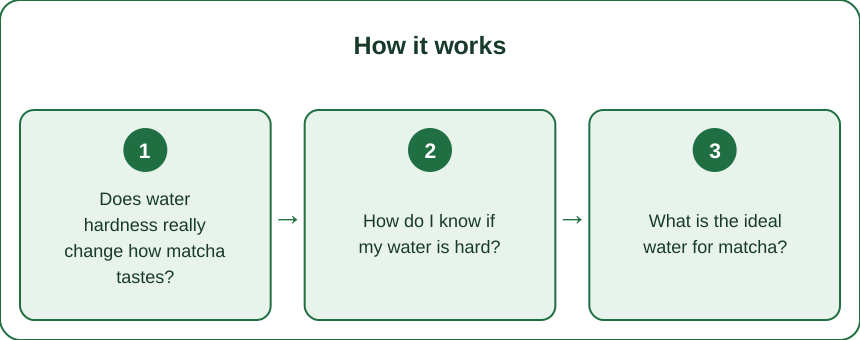
Does water hardness really change how matcha tastes?
Yes, and more than most people expect. Matcha is roughly 99% water by volume - which means the water is not a delivery system, it is the majority ingredient.
Hard water carries dissolved calcium and magnesium. Those ions interact with L-theanine (the amino acid responsible for matcha’s sweet, brothy quality) and with the catechins that produce astringency. The practical result: sweetness gets muted, astringency gets amplified.
Coffee people have known this for years - the Specialty Coffee Association actually publishes a target water spec. Tea has the same physics and almost none of the attention.
If your matcha tastes chalky, flat, or oddly drying even with fresh ceremonial-grade powder, water is the first thing to test.
How do I know if my water is hard?
Three checks, cheapest first.
The kettle test. Look inside your electric kettle. White crusty scale on the element or the base means calcium carbonate is precipitating out - that is hard water, no lab required.
The soap test. If soap struggles to lather and leaves a film on glassware, you are in the 150+ ppm range.
The utility report. Most US municipal water systems publish an annual water quality report online, and hardness is listed in grains per gallon or mg/L. Anything over about 120 mg/L (7 grains) is firmly hard.
A $10 TDS meter gives you a number in five seconds, and it is the single most useful gadget a serious matcha drinker can own.
What is the ideal water for matcha?
You want water with some mineral content, not zero.
- Target: 30-80 ppm TDS. This range has enough mineral to carry flavor without enough to bind it up.
- Distilled or reverse-osmosis water tastes hollow. With no minerals at all, matcha loses body and reads thin and papery. Pure water is not the goal.
- A basic carbon pitcher filter (the kind that lives in your fridge door) removes chlorine but does not remove hardness. It helps with off-flavors, not with minerals.
- Soft bottled spring water is the easy win. Check the label for TDS or mineral content - many popular brands print it.
If you are on well water in a hard-water region, a small countertop RO unit plus a remineralizing cartridge is the permanent fix.
Myth vs Fact: the water myths that keep costing people money
Myth: Boiled water is softened water. Fact: boiling precipitates some temporary hardness as scale, but it concentrates everything else as water evaporates. Boiling then cooling can leave water slightly harder, not softer.
Myth: A filter pitcher fixes hardness. Fact: standard carbon filters target chlorine, sediment, and taste compounds. Hardness needs ion exchange or reverse osmosis. Read what your filter actually claims.
Myth: Expensive matcha is immune to bad water. Fact: the opposite. Ceremonial grade has more delicate aromatics to lose. Cheap culinary matcha is already bitter enough that hard water barely registers - you are wasting good powder, not bad.
Myth: If it looks green, it tasted fine. Fact: color tracks freshness and grade. It tells you nothing about the water.
Myth: Water softeners help. Fact: home softeners swap calcium for sodium. Your matcha will taste faintly salty and flat. Softened water is for pipes, not for tea.
What temperature should the water actually be?
160-175°F (71-79°C). That is the working window, and it matters more once your water is right.
No thermometer? Boil, then let the kettle sit uncovered for 2 minutes - that drops most kettles into range in a normal kitchen. Pouring into a cold bowl drops it another 5-10°F, so warm the bowl first with a splash of hot water and dump it.
Water that is too hot extracts catechins fast and you get that scraping bitterness. Too cool and the powder never fully suspends, which reads as gritty rather than bitter.
Order of operations that works: warm the bowl, sift 2 g of matcha, add 2 tablespoons of 170°F water, whisk to a smooth paste, then add the remaining 4 oz. The paste step is what kills clumps.
What about iced matcha and matcha lattes?
Iced matcha exposes water problems more, not less. Cold masks sweetness and leaves astringency standing alone, so hard water in an iced drink tastes noticeably harsher.
For iced: whisk with a small amount of the same 170°F filtered water first, then pour over ice and top with cold filtered water. Whisking directly into cold water leaves you with suspended grit that settles in ninety seconds.
For lattes, milk covers a multitude of sins - the fat and protein bind the astringent compounds. If you drink matcha exclusively as a latte, water quality genuinely matters less. Save the good water for the days you drink it straight.
And this is the season for it: as mornings start cooling into fall, the hot-bowl version comes back into rotation and every flaw gets easier to taste.
FAQ: Matcha Water Questions, Answered
Can I just use bottled water and be done?
Yes, if you pick one in the 30-80 ppm range and stick with it. Consistency is half the battle - switching brands week to week is why your matcha tastes different every time.
Does a Brita or similar pitcher help at all?
Somewhat. It removes chlorine, which causes its own chemical off-note, and that is a real improvement. It does not reduce hardness meaningfully. Think of it as fixing a different problem.
My matcha tastes fine at a cafe but bad at home. Why?
Cafes usually run filtered water on the espresso line, and they use it for tea too. That, plus fresher powder from higher turnover, explains most of the gap.
TL;DR:
- Water is ~99% of your matcha - hard water binds the compounds that make it taste sweet and brothy.
- Target 30-80 ppm TDS. Distilled tastes hollow; hard tap tastes chalky and bitter.
- Check your kettle for scale - that white crust is your diagnosis, free.
- Carbon pitcher filters do not remove hardness, and boiling does not soften water.
- 170°F, sift, paste first, then top up. Water fixed, technique fixed, done.
If you have been slowly working through tins wondering why nothing tastes like it did in the shop, try one bowl with soft bottled water before you buy anything else. It is a two-dollar experiment that usually ends the search.
Keep Reading
This article is for general informational purposes only and is not medical advice. Always consult a qualified health professional for guidance specific to you.