How to Store Matcha So It Still Tastes Fresh in Week Six
Quick Answer: Matcha degrades through four channels: oxygen, light, heat, and moisture. Store the opened tin in an airtight container in the refrigerator, let it come to room temperature for ten minutes before opening to prevent condensation, and finish it within six to eight weeks. Do not store it in the freezer once opened, and do not keep it next to the stove — those two habits kill more tins than cheap powder ever did.
Matcha is not like coffee beans, which forgive a few weeks on the counter. It is a powdered leaf with enormous surface area, and every gram of it is exposed to whatever the air in the tin is doing. The green fades, the sweetness goes first, and the bitterness stays — which is why old matcha does not taste weaker, it tastes worse.

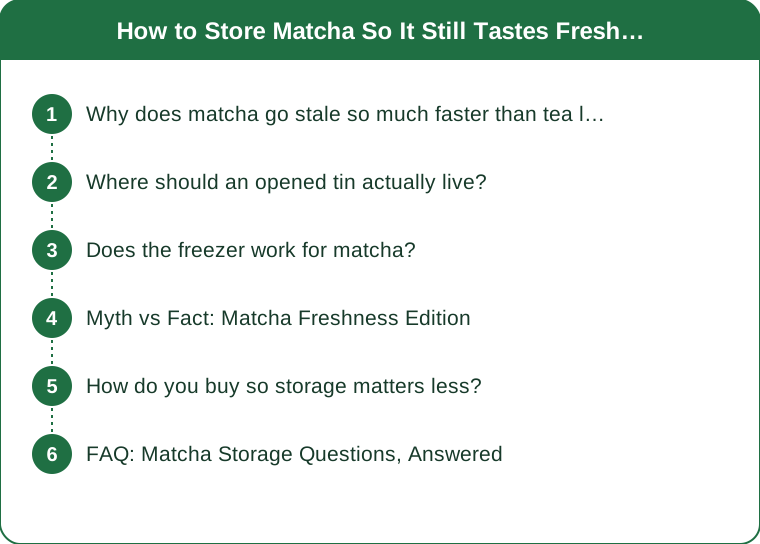
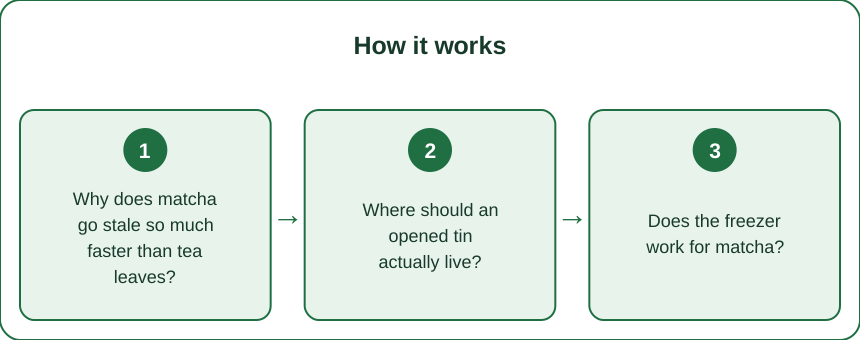
Why does matcha go stale so much faster than tea leaves?
Surface area, mostly.
A whole tea leaf exposes a tiny fraction of itself to air. Grind that leaf into a powder measured in microns and you have multiplied the exposed surface thousands of times. Oxidation that takes a loose-leaf tea a year happens to matcha in weeks.
The compounds that fade first are the ones you paid for. Theanine, the amino acid behind matcha’s sweet, savory depth, breaks down quickly with oxygen and heat. Chlorophyll, which gives the powder its electric green, degrades under light into dull olive pheophytin. Catechins — the bitter ones — are comparatively stable.
So an aging tin does not fade evenly. It loses sweetness and color while keeping bitterness, shifting the whole balance of the cup. If your morning bowl has been getting sharper since midsummer and you changed nothing about your technique, the calendar is your answer.
Heat accelerates every one of these reactions. A tin living next to the kettle or in an un-air-conditioned August kitchen ages roughly twice as fast as one in the fridge.
Where should an opened tin actually live?
In the refrigerator, inside a second airtight container.
The fridge solves heat and slows every oxidation reaction meaningfully. The second container solves the fridge’s own problems: odors and humidity. Matcha absorbs smells with enthusiasm — an unprotected tin next to leftover curry will tell you about it — and every door opening swings the humidity.
The non-negotiable detail: let the tin sit at room temperature for about ten minutes before you open it. Cold powder meeting warm kitchen air grows condensation instantly, and moisture is the one enemy you cannot undo. Damp matcha clumps, dulls, and can eventually grow things you do not want to drink.
If your kitchen stays below about 72F and the tin will be gone within three weeks, a dark cupboard away from the stove is honestly fine. The fridge earns its keep when the tin will be open longer than a month, when the kitchen runs hot, or when you bought a larger bag than you should have.
Unopened tins are a different story — the fridge or freezer is ideal, since the sealed, often nitrogen-flushed packaging removes the condensation risk until the day you break the seal.
Does the freezer work for matcha?
For sealed packages, yes. For opened ones, almost never in practice.
The theory is fine: colder is slower, and a freezer holds matcha’s chemistry nearly still. Professional suppliers store sealed inventory frozen for months. The problem is the thaw cycle. An opened container coming out of a 0F freezer into a humid kitchen is a condensation machine, and most people will not wait the 30-plus minutes a frozen tin needs to fully temper before opening.
Do that dance every morning and you introduce a little moisture every day, which is worse than the warmth you were avoiding.
The workable version: portion before freezing. Divide a large bag into week-sized amounts in small airtight jars, freeze them all, and move one jar at a time to the fridge as you go. Each jar gets opened across only a week, and the bulk supply never cycles.
For the standard 30g tin most people buy, skip the freezer entirely. Fridge, airtight, ten-minute rest, done in six weeks. The freezer is a bulk-buyer’s tool, not an upgrade for everyone.

Myth vs Fact: Matcha Freshness Edition
Myth: Matcha lasts a year because the label says so. Fact: The best-by date describes a sealed, nitrogen-flushed package. Once opened, the realistic window for peak flavor is six to eight weeks, stored well. The label date and the opened lifespan are two different clocks.
Myth: Faded color is cosmetic. Fact: Color is chemistry you can see. The same reactions that turn chlorophyll olive are degrading flavor compounds in parallel. Army-green powder will still be safe, but it will whisk into a flat, sharp cup.
Myth: A clip or rubber band on the bag is enough. Fact: A rolled bag exchanges air constantly. Matcha needs a genuinely airtight seal — a tin with a tight lid or a jar with a gasket. If the bag it came in reseals poorly, decant it on day one.
Myth: Stale matcha should be thrown out. Fact: Demote it instead. Powder past its prime is perfect for lattes, smoothies, overnight oats, and baking, where milk and sweetness cover the lost delicacy. Reserve the fresh tin for straight bowls and iced whisks, and let the old one finish its life in a banana bread.
How do you buy so storage matters less?
Buy small, buy often, and match the size to your actual habit.
A 30g tin makes roughly 15 traditional bowls. If you whisk one bowl a day, that is a two-week supply — well inside the freshness window with room to spare. The 100g bag that looked like a better per-gram deal is a six-week commitment at minimum, and for a two-bowls-a-week person it is a guaranteed stale finish.
The per-gram math almost always loses to the per-good-cup math. Paying 20 percent more per gram for powder you finish at peak beats a discount on powder you stop enjoying in week five.
Check for a packed-on or harvest date where brands offer one; spring-harvest matcha packed soon after milling is the freshest start you can buy. Late summer is also when retailers discount the spring stock — a genuine bargain if the package is sealed and you will open it soon, a trap if it joins a queue of three other open tins.
One open tin at a time is the quiet rule that fixes most matcha problems before they start.
FAQ: Matcha Storage Questions, Answered
How can I tell if my matcha has gone off?
Three checks: color shifted from vivid green toward olive or brown, aroma gone from fresh-grassy to hay-like or flat, and taste turned sharp with no sweetness behind it. Any two of the three means demote it to lattes and baking.
Can I store matcha in a clear glass jar?
Only inside a dark cupboard or fridge. Glass with a good gasket seals beautifully, but light degrades chlorophyll within days on a bright counter. If the jar lives anywhere visible, wrap it or choose an opaque tin instead.
Does the little sifter tin from the cafe count as airtight?
Usually not. Many gift tins have loose slip lids that let air cycle freely. Press the lid on and turn the tin upside down over a sink — if you would not trust it, decant into something with a proper seal.
Is refrigerated matcha too cold to whisk properly?
No. The ten-minute counter rest that protects against condensation also brings the powder close enough to room temperature that it sifts and whisks normally. Cold powder straight from the tin clumps slightly more, which the rest solves on its own.
TL;DR:
- Oxygen, light, heat, and moisture age matcha; powder form makes it happen in weeks, not months.
- Opened tins live in the fridge inside an airtight container, with a ten-minute rest before opening to block condensation.
- Freezing is for sealed or pre-portioned bulk only — daily freezer cycling adds the moisture you were avoiding.
- Buy 30g at a time unless you drink daily; one open tin at a time, finished in six to eight weeks.
The difference between week-one and week-six matcha is mostly decisions you make on day one. Decant it, chill it, and the last bowl in the tin will taste like the first.
Keep Reading
This article is for general informational purposes only and is not medical advice. Always consult a qualified health professional for guidance specific to you.