Does Eating With Your Matcha Actually Change How the Caffeine Hits?
Quick Answer: Matcha consumed with food is absorbed more gradually than matcha on an empty stomach, which softens the initial caffeine spike and reduces the odds of jitteriness — but the total caffeine dose you consume doesn’t change, only the pace at which it hits.
A lot of people notice matcha feels sharper and more jittery some mornings than others, and the difference usually isn’t the matcha — it’s whether anything else was in their stomach at the time.

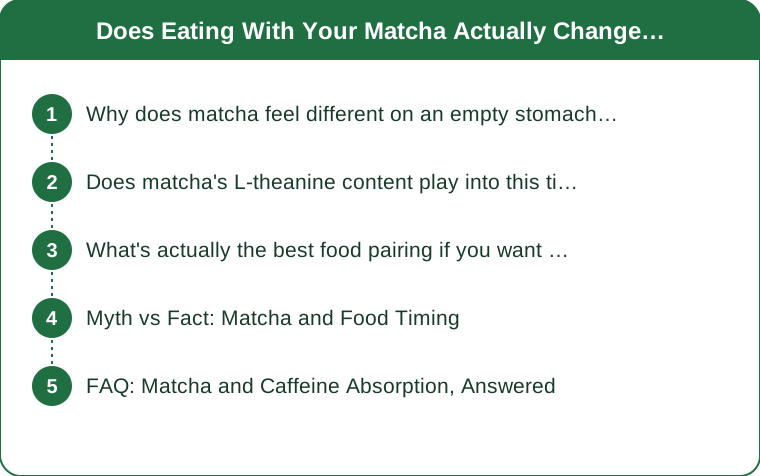
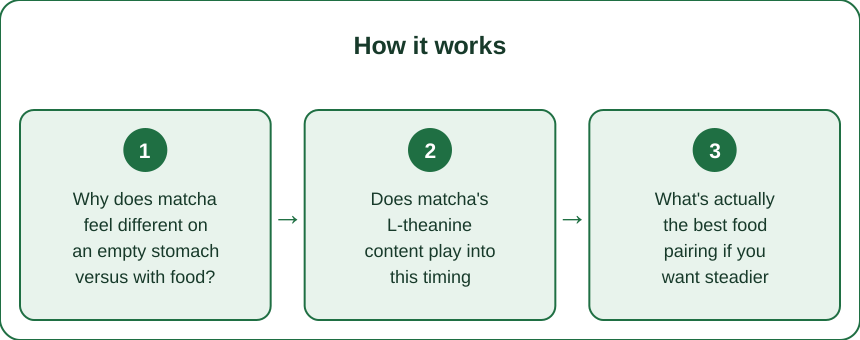
Why does matcha feel different on an empty stomach versus with food?
Caffeine absorption speed is heavily influenced by what else is in the digestive tract at the time. On an empty stomach, caffeine moves into the bloodstream faster, producing a quicker, sharper rise in alertness — and for some people, a corresponding quicker rise in jitteriness or a racing feeling, especially at higher matcha doses.
Eating alongside matcha, particularly something with fat, fiber, or protein, slows gastric emptying, which spreads the caffeine absorption out over a longer window. The total amount of caffeine you consumed doesn’t change — matcha still delivers roughly the same caffeine per gram regardless of what you eat with it — but the curve of how quickly it hits your system flattens out.
Does matcha’s L-theanine content play into this timing effect too?
Matcha’s well-known caffeine-plus-L-theanine combination is part of why it’s often described as calmer energy than coffee, and food timing interacts with this too. L-theanine, an amino acid naturally present in tea leaves, is thought to modulate some of caffeine’s stimulating effects, producing steadier focus rather than a sharp spike — but this effect happens regardless of whether you eat alongside it.
What food timing changes is specifically the caffeine absorption curve, not the L-theanine effect — so pairing matcha with a meal essentially combines two separate smoothing mechanisms (L-theanine’s inherent buffering, plus slower absorption from food), which is part of why a with-breakfast matcha often feels notably gentler than the same matcha on its own first thing in the morning.

What’s actually the best food pairing if you want steadier matcha energy?
A meal or snack containing some protein and fat — Greek yogurt, eggs, nut butter on toast — slows gastric emptying more effectively than a purely carbohydrate-heavy option like plain toast or juice alone. This isn’t about a specific magic food, it’s about giving the stomach something substantial to work through alongside the matcha.
For people specifically prone to jitters or an afternoon crash, drinking matcha during or right after a meal, rather than 30+ minutes before eating, tends to produce the smoothest experience, since the food and caffeine end up processing through the digestive system together rather than the caffeine getting a head start.
Myth vs Fact: Matcha and Food Timing
Myth: Eating with matcha reduces the total caffeine you absorb. Fact: The total caffeine absorbed is essentially the same either way — food changes the speed of absorption, not the overall amount that eventually reaches your bloodstream.
Myth: Matcha on an empty stomach is always the ‘wrong’ way to drink it. Fact: Some people specifically prefer the quicker, sharper alertness of empty-stomach matcha, particularly for a fast pre-workout boost — it’s a preference and use-case question, not a right-or-wrong one.
FAQ: Matcha and Caffeine Absorption, Answered
Does matcha on an empty stomach cause an upset stomach for some people?
Yes — the concentrated catechins and caffeine in matcha can irritate an empty stomach for some people, showing up as mild nausea or discomfort, which is a separate issue from the caffeine-timing effect but another reason food pairing helps many people.
How long does the caffeine effect from matcha typically last?
Matcha’s caffeine effects are commonly reported to last longer than coffee’s for many people, often extending several hours, partly attributed to the L-theanine interaction and partly to the naturally slower catechin-bound caffeine release from whole tea leaf versus brewed coffee.
Should I avoid drinking matcha right before a workout on an empty stomach?
It depends on your individual tolerance — some people specifically like the sharper, faster energy for pre-workout use, while others find the quicker spike uncomfortable during exercise; testing on a lower-stakes day rather than before a key session is the safer way to find out which applies to you.
TL;DR:
- Food doesn’t change how much caffeine you absorb from matcha, only how fast
- Protein-and-fat pairings (yogurt, eggs, nut butter) smooth the absorption curve the most
- Empty-stomach matcha hits faster and sharper — useful for some, jittery for others
- Drinking matcha during or right after a meal produces the gentlest experience
If your afternoon matcha feels rougher than your morning one, check what (if anything) was in your stomach at the time before blaming the matcha itself.
Keep Reading
This article is for general informational purposes only and is not medical advice. Always consult a qualified health professional for guidance specific to you.